

Nallur was the ancient capital of the Jaffna Kings, now it is an affluent suburb of Jaffna Town. Elegant tree lined streets give a glimpse of its former glory, and it is worth the short tuk tuk drive from the centre to visit the sites.
Old Park
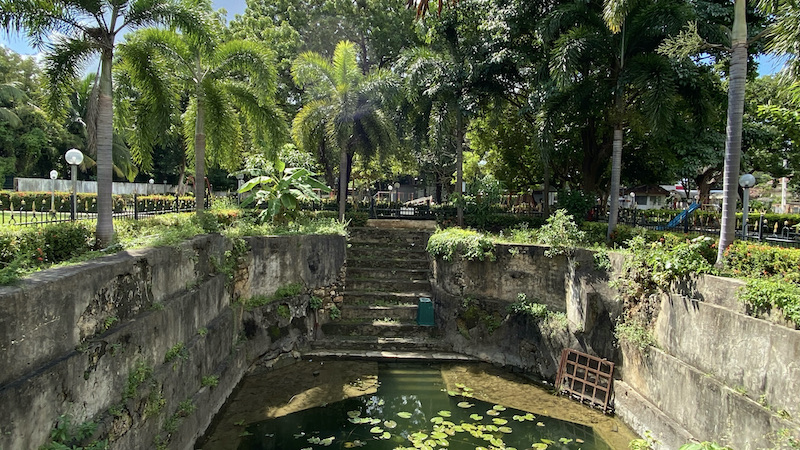
About four kilometres from the centre of town is the lovely Old Park. Originally laid in 1829, the twenty seven acre park was designed as a pleasure garden for the British Residency. A wide range of flowering and fruit bearing trees was planted and a stepped pond. It is still a very well kept cool, green haven with the addition of children’s playgrounds and a small café.
Old Kachcheri
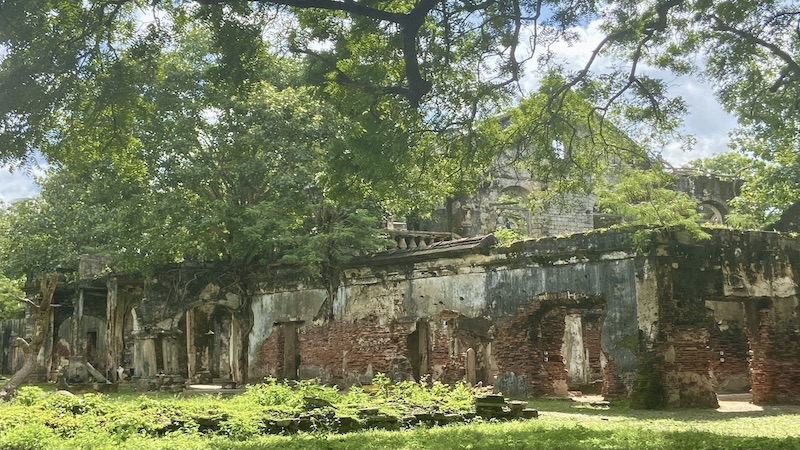
The Old Kachcheri (administrative building) was possibly built in the mid to late 18th century. In the 19thcentury it was used by the British and then the Sri Lankan Government until 1990 when it was captured by the LTTE and used as their Police Headquarters. After they were driven out the building was left unused, in 2000 another LTTE attack caused the roof of the building to be blown off.

Only the thick walls and some internal arches remain now of this once splendid building.
The Minister’s House (Mantre Mandir)

As so often the case here the exact history of this beautiful building is a bit vague. Some say it was built during the Dutch period, some think is a 19th century guesthouse. There is an inscription saying it was built by Thampifilla in 1890. Other historians believe it was once one of the palaces of a minister of King Cankili. Certainly the ornamental work on the pillars, capitals and the arched porch appear to belong to the Jaffna kingdom’s era.

Whichever is true it is well worth wandering round and admiring the old architectural style. Go through the large arched porch under the tower and see the wooden carvings in the interior. It was a two storey building. There is also a well, wash basin, cellar and a staircase leading down to underground rooms and secret tunnels.
Yamuna Eri
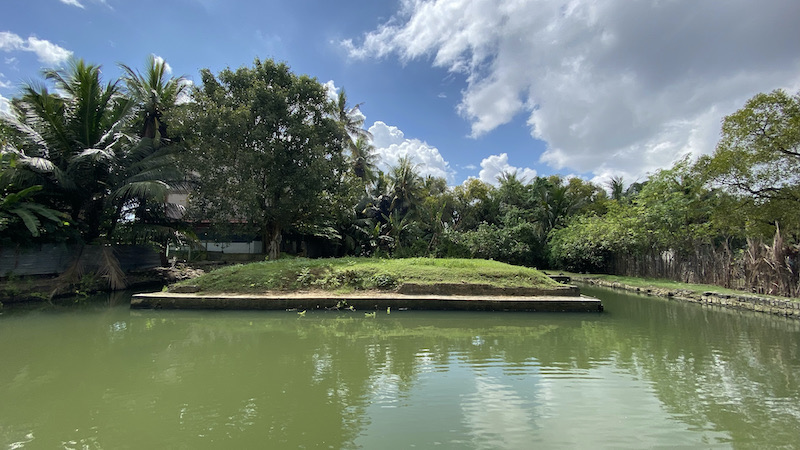
Turn off the main road near the Minister’s House and the Cankillian Thoppuarch and work your way through several back streets and you come across another ruin from the early days of the Jaffna kingdom. The Yamuna Eri is a three sided well in the shape of the Tamil letter ப. Built of bricks during the reign of King Cinkai Ariyan Cekaracacekaran (1215-1240) it is 30 feet deep and has stone steps to allow for bathing. Ancient texts describe the King bringing sacred water from the Yamuna River in India and mixing it with the pond water.
In the centre was a decorative flower garden, sadly now just grass. A tunnel links the Yamuna with the Minister’s House.
Legend also says that the pond was used for ritual bathing on holy days at the Nallur Kandaswamy Temple
The Arched Gateway of Caintili (Cankilian Thoppuarch)
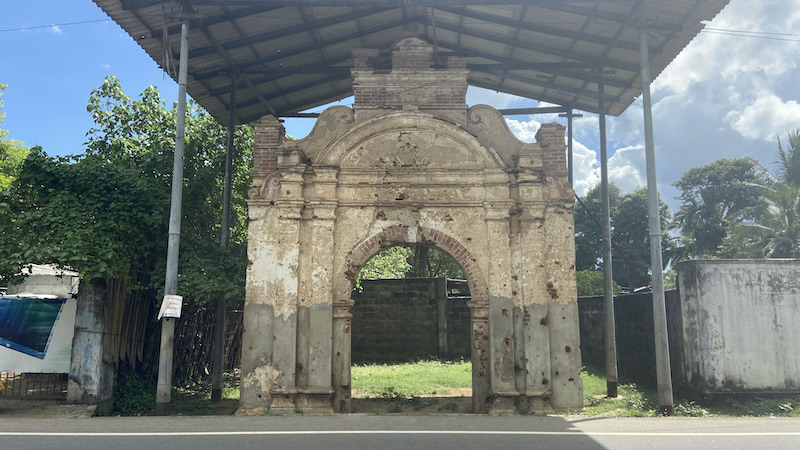
Just 90 metres to the north of The Minister’s House this old, isolated gateway is from the Dutch colonial period its style evocative of the medieval kingdom of Jaffna. The stone arch claimed by some to have been the entrance to the palace of King Cankili (1519–65), though others assert, perhaps more credibly, that it was part of the 17th-century home of Poothathamby Mudaliyar, a Tamil administrator executed by the Dutch for treason”
There are few remains of the royal palace to be seen through the gateway.
Nallur Kandaswamy Kovil

This huge temple dedicated to Skanda/Lord Murunga, the powerful go of love, war and beauty, is about half a mile from Jaffna town centre on the Point Pedro Road. Originally built in the 10th century it was destroyed by the Portuguese. The current building dates from the 19th century.
Male visitors must take their shirts off, and if wearing shorts are given a sarong to wrap around. Females must have shoulders covered and shorts/ skirts that cover the knees. All forms of photography are strictly forbidden inside.

In my experience it is one of the less friendly temples to visit. You have to run the gamut of a group of beggars at the gate and leave your shoes with them. I am still not clear if the temple only opens for the five daily pujas (held at 05.00, 10.00, 16.00, 17.00 and 18.45) or whether it is open from 15.00-19.00. It was pouring with rain when I got there, and they refused to unlock an entrance gate early so that I could take shelter.
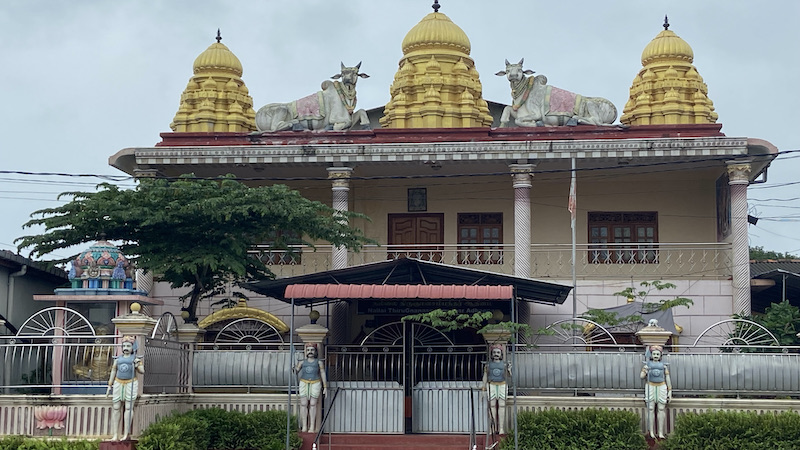
Having said that it is an impressively vast structure inside. Outside are two new nine-storey gopurams, said to be the tallest and second tallest in Sri Lanka, completed in 2011 and 2015 respectively. Gallons of gold paint must have been used inside and out.

Thousands of people will attend the twenty five day Nallur Festival which ends late August or early September.
Archaeological Museum
I will confess to not having visited the museum as I ran out of time on this visit. So I can only quote from the information sheet. “It is hidden behind the Navalar Cultural Hall 1km south of Nallur Temple. Inaugurated in 1985 there are eight rooms of exhibits These include a collection of Medieval statues and carvings excavated at the ancient temple sites, a good example of an old palmyrah-leaf manuscript, also dating to the 17th century. From Jaffna Fort came a gravestone complete with skull-and-crossbones, a brass sundial, and a war-scarred 1853 portrait of a 34-year-old Queen Victoria said, rather fancifully, to smile at the viewer at certain angles.”

 Janet's Journal
Leave a comment